
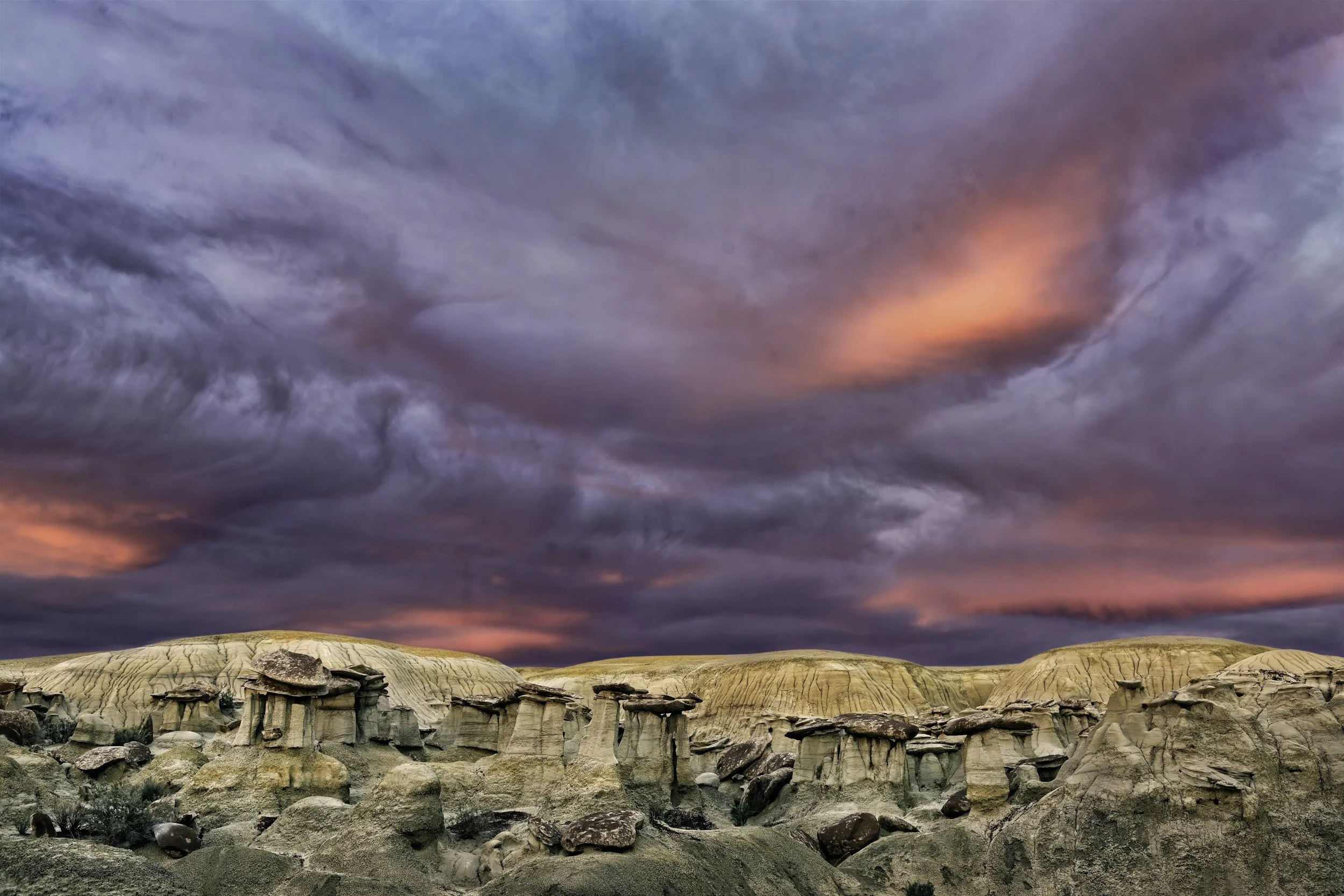
New Mexico is not just a place. It's an attitude.
The ground reflects that — unpredictable, independent, not interested in behaving the way people expect. Neither are most New Mexicans. Neither is the way we approach foundation work.
TLS Foundations was built here, by people who chose to be here, who have spent their working lives learning this specific place — its geology, its climate, its construction history, its communities, its particular combination of landscape and culture that produces a ground condition unlike anywhere else in the country.
That is not a marketing statement. It is the operational reality that determines every evaluation we do, every recommendation we make, and every method we apply. You cannot fake 25 years of New Mexico field work. You cannot acquire it. You cannot download it. It accumulates the same way the miles accumulate — one site visit at a time, across every formation in the state, until the ground stops surprising you.
Thirty-three counties. Different soils, different structures, different green chile cheeseburger arguments. We know them all. This is the Land of Entrapment — and we are not leaving.
The Rio Grande Rift runs the length of the state — a zone where the earth's crust is actively pulling apart, filling long basins with thousands of feet of sediment. Those basin sediments range from expansive clays to collapsible desert silts to alluvial river gravels, sometimes within a few miles of each other. The mountain ranges that frame the basins produce their own soil character at their margins. The high desert plains, the Colorado Plateau, the Permian formations of the southeast, the volcanic fields — each brings its own geological history and its own foundation implications.
What this means in practice: a repair method that works reliably in the South Valley may be the wrong choice in Rio Rancho two miles away. The soil under a foundation in Corrales — alluvial, moisture-influenced by centuries of acequia irrigation — behaves differently than the soil under a foundation in Tijeras, where bedrock proximity and elevation change the calculation entirely. Socorro sits in a seismically active corridor on Rio Grande alluvial deposits with specific liquefaction considerations that do not apply in Albuquerque's East Mesa neighborhoods.
A national company operating from a standardized playbook cannot account for that variation. Their evaluation process is designed for a generic soil condition that does not exist in New Mexico. The method gets selected before the soil is understood. The result is a repair that addresses the symptom the company knows how to treat rather than the condition the soil actually presents.
See our full reference: Why Foundations Move in New Mexico →
Regional geotechnical knowledge takes decades to build. It accumulates from showing up in the same formations, in the same climate, across multiple construction eras and moisture cycles, until the site reads before the boring goes in. That kind of knowledge isn't in any training manual. It lives in the people who have done the work — in this state, in these soils, long enough for the ground to stop surprising them.
We work closely with geotechnical engineers and refer to them often. That relationship works because we speak the same language — not because we took a course, but because 25 years of New Mexico field work produces a shared frame of reference. When an engineer hands us an investigation report, we know what it means for the repair. When we refer a homeowner to an engineer, we know who to call for which formation.
That knowledge base — built across every region of the state and informed by geotechnical investigation through our affiliate Sandia GEO — was assembled here and remains here. In the people doing the work.
Six things that are structurally different about the way TLS works.
Investigation before recommendation
No method is selected before the soil profile is understood. The investigation confirms, refines, and documents what the ground is doing. It does not rubber-stamp a decision already made before the site visit.
Drainage referred out honestly
When drainage correction is the right first step — and in New Mexico it often is — we say so and refer to contractors who do that work well. Starting with piers when drainage correction would suffice is not a service. It is a sale. If it's wet, keep it wet. If it's dry, keep it dry.
Monitoring as a real recommendation
When the evidence does not support structural intervention, we recommend monitoring. A documented baseline, a return visit, a determination of whether movement is active or historic. Most companies cannot afford to recommend this. We can.
Honest about method limitations
Every repair method has conditions where it fails. We explain those conditions — including when helical piers are the wrong choice, when push piers won't work in light New Mexico residential construction, and when foam injection is being sold as something it is not.
Investigation revenue changes the equation
Geotechnical investigation through our affiliate Sandia GEO means the evaluation is never a loss leader for a repair sale. The recommendation can follow the evidence without financial consequence for being honest.
Custom solutions when standard methods don't fit
When the soil profile, structural conditions, or access constraints put a situation outside what standard systems address, we design around the problem. The goal is the right answer — not the nearest available product in the lineup.
Why this business works the way it does.
We solve problems. We do not sell products. In New Mexico, that distinction matters more than anywhere else — because the problems here are genuinely different, and a product sold without understanding the problem is worse than no repair at all.
Most foundation repair companies are sales organizations. The evaluation visit exists to close a contract — shaped by what the company sells, what generates the largest invoice, and what the estimator is trained to identify as an opportunity. The homeowner is rarely in a position to know whether the recommendation is right. That is precisely why the model works for the company.
TLS was built as the opposite. Two owners who came out of the industry, watched it become something they disagreed with, and built a structure where honesty has no financial consequence — investigation revenue, referred work, monitoring when repair is premature. Anti-sales pressure is not a positioning statement. It is how the business is designed.
"The Land of Entrapment. We chose it too."
New Mexico. It is not a state that inspires indifference — you either understand it or you don't, and most people who understand it stay.
We won't promise you a free estimate, but let's talk.
Text or call — you reach the owner(s).